
13 August 2026
Onion Futures Act: How Two Traders Crashed the Market
Two traders took control of almost all of Chicago's stored onion supply, helped crash the price, and sparked a federal ban that still exists today.
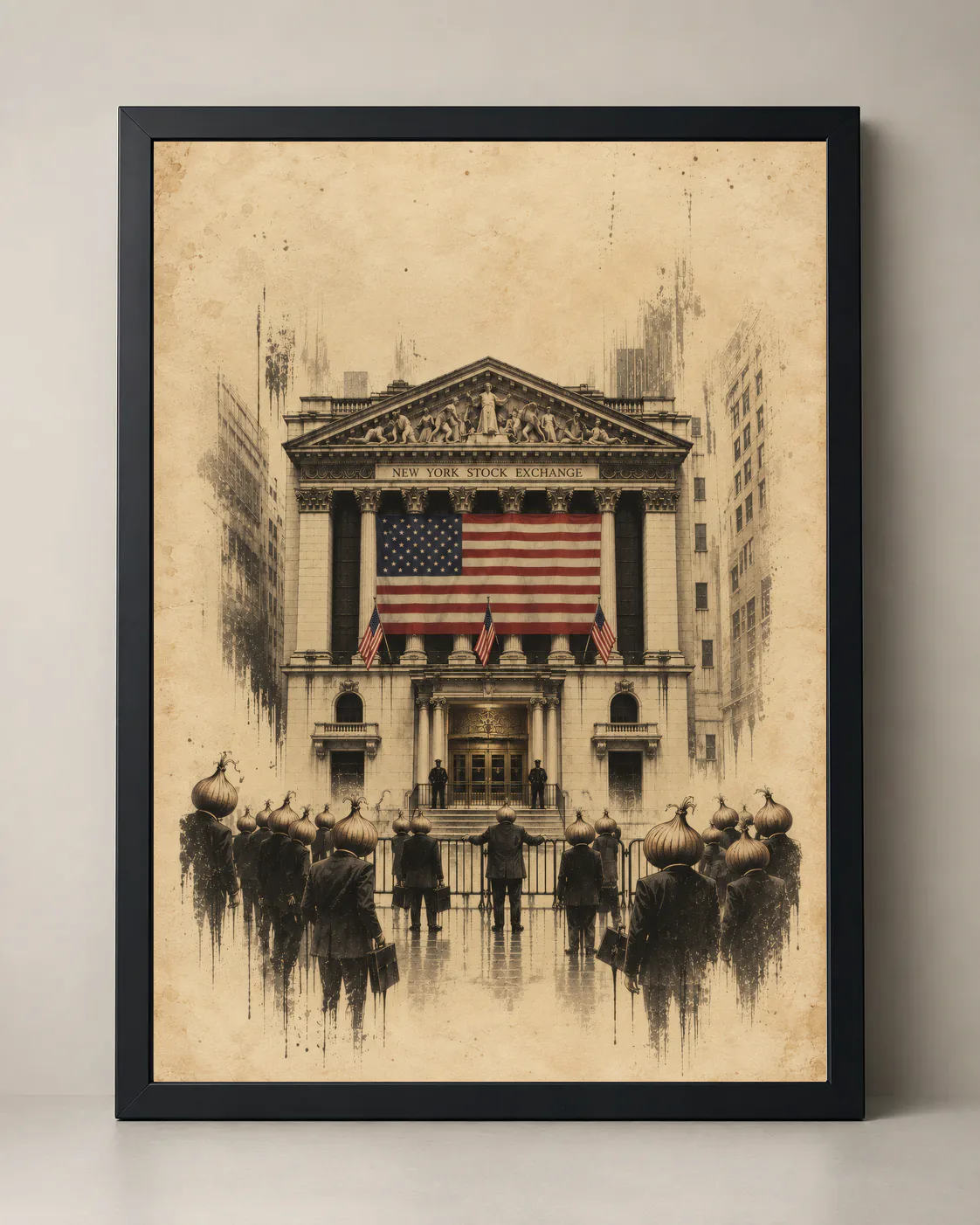
In 1955, onion trader Vincent Kosuga and produce dealer Sam Siegel gained control of almost all the onions that could be delivered in Chicago. They later built large bets on prices falling. In March 1956, onion futures crashed to 10 cents for a 50-pound bag. Congress later banned onion futures trading.
Why are onion futures banned in the United States?
Onion futures are banned because Congress passed the Onion Futures Act in 1958. The law followed a major market manipulation case involving Vincent Kosuga and Sam Siegel. Their trading helped push March 1956 onion futures down to record lows. The federal ban is still in force today.
Before the ban, onions were traded on the Chicago Mercantile Exchange. A futures contract let a buyer and seller agree on a price for onions to be delivered later. Farmers could use these contracts to protect themselves from falling prices. Traders could also use them to bet on where prices would move. By the 1950s, onions had become an important part of the exchange.
The market became a problem after the 1955 crop. Kosuga and Siegel built huge positions in both real onions and onion futures. Their actions drew the attention of the Commodity Exchange Authority, which was the federal regulator at the time. In June 1956, the agency filed a formal case against them. Congress then began hearings on whether onion futures should be banned.
| Fact | Detail |
|---|---|
| Date | 1955–1956 |
| Location | Chicago, Illinois, United States |
| Key figures | Vincent W. Kosuga; Sam S. Siegel |
| Outcome | Kosuga and Siegel were found to have manipulated onion prices downward. Congress later banned onion futures trading. |
| Status today | Federal law still bans futures contracts on onions on US exchanges under 7 U.S.C. § 13-1. |
Who were Vincent Kosuga and Sam Siegel?
Vincent Kosuga was an onion grower and trader from Pine Island, New York. Sam Siegel was a Chicago-area produce dealer and futures trader. Both were members of the Chicago Mercantile Exchange. Together, they became the main figures in the onion market case that led to the federal ban.
Kosuga knew onions from both sides of the business. He grew and shipped them, but he also traded onion futures on the Chicago Mercantile Exchange. Siegel ran National Produce Distributors, a wholesale produce company near Chicago. He also traded onions and futures. This meant the two men could deal in the real crop while also taking positions on its future price.
The official case shows that their work became closely linked. Siegel handled onions owned by Kosuga. The men also made deals with other growers and traded in a similar way at key points. The regulator later rejected their claim that they had acted on their own. It found that their shared positions and control of physical onions were part of the same market plan.
The prices of March futures and cash onions in Chicago after mid-February were not the result of supply and demand but were artificial.
— U.S. Department of Agriculture, decision in Vincent W. Kosuga, Sam S. Siegel and National Produce Distributors, Inc., 1960 (source)
How did Kosuga and Siegel corner the onion market?
Kosuga and Siegel gained control of almost all the onion stocks in Chicago that could be used for futures delivery. At the end of December 1955, they held 98 percent of Chicago's cold-storage onions. Across Chicago and other storage points, they controlled about 1,000 carloads that could be made available.
One futures carload was about 600 bags, with each bag weighing 50 pounds. That means 1,000 carloads came to about 30 million pounds of onions. This was not 30 percent of every onion in the United States. The key fact was more specific: the men had an almost complete hold over the onions that could be delivered into the Chicago futures market.
That control gave them power over other traders. If they held the onions back, supply on the exchange stayed tight. If they sent large amounts into the market, prices could fall. In late 1955, Kosuga and Siegel made a deal with a group of growers. The growers agreed to buy 287 carloads, while Kosuga and Siegel agreed to keep other onions away from the exchange.
How did they crash the price of onions?
After first helping support onion prices, Kosuga and Siegel moved to the other side of the market. They built large short positions, which meant they could gain if prices fell. They also held most of the onions that could be delivered. The federal regulator later found that their actions helped create an artificial price crash.
By February 1956, the two men held a combined short position of 1,161 carloads in the March futures contract. That was more than 44 percent of all open positions in that contract. At the same time, they still held most of Chicago's cold-storage onions. They had both a large bet on falling prices and a large supply of real onions that could hang over the market.
Some of their stored onions had started to rot. Siegel sent about 60 carloads from Chicago to Iowa so they could be sorted and packed again. About 25 carloads then came back to Chicago. The regulator found that these movements, their large short positions, and their heavy deliveries at the start of March all pushed the market down. Prices began to fall fast.
How low did onion prices fall?
The March 1956 onion futures price fell to a low of 10 cents for a 50-pound bag on 15 March. It closed that day at 15 cents. A month earlier, the contract had closed at $1.16. The federal ruling found that the fall was not caused by normal supply and demand alone.
The fall was huge. On 15 February, March onion futures closed at $1.16 per 50-pound bag. One month later, the price touched 10 cents. That was a fall of about 91 percent. The regulator said these were the lowest onion futures prices ever recorded on the Chicago Mercantile Exchange. Cash onion prices also fell, though not as sharply as the futures price.
A new Texas onion crop also put some pressure on prices. The federal ruling says this mattered, so the crash should not be blamed on Kosuga and Siegel alone. But it also found that their trading made the prices artificial and helped drive them down. Both men closed their futures positions during the first week of March at a profit.
Is onion futures trading still banned today?
Yes. Federal law still bans futures contracts on onions on US exchanges. President Dwight D. Eisenhower approved the Onion Futures Act on 28 August 1958. The rule is now found at 7 U.S.C. § 13-1. More than sixty years later, the onion ban remains part of US law.
The 1956 market case caused anger among onion growers and drew Congress into the fight. Lawmakers held hearings on whether futures trading was helping farmers or making the market easier to abuse. Congress chose the strongest answer. It did not only create new limits for onion contracts. It stopped exchange-traded onion futures altogether. The ban became law in August 1958.
The law is still unusual. Onion futures cannot be traded on a US board of trade, even though futures exist for many other farm goods. The law was changed in 2010 to also cover motion picture box office receipts, but the onion rule itself stayed in place. A market fight from the 1950s is therefore still written into federal law today.
Sources
- U.S. Department of Agriculture - Vincent W. Kosuga, Sam S. Siegel and National Produce Distributors, Inc.
- Commodity Futures Trading Commission - Futures Regulation Before the Creation of the CFTC
- U.S. Government Publishing Office — Onion Futures Act, Public Law 85-839
- Commodity Exchange Authority — Futures Trading in Onions
Lost Axis Editorial
Researches each story from primary sources · About Lost Axis →
Early access to each new edition, before it's public.