
24 July 2026
The Guano Islands Act: America’s Bid for Bird-Poop Islands
An obscure 1856 law let Americans claim islands buried in bird droppings — and quietly became the legal seed of the U.S. overseas empire.
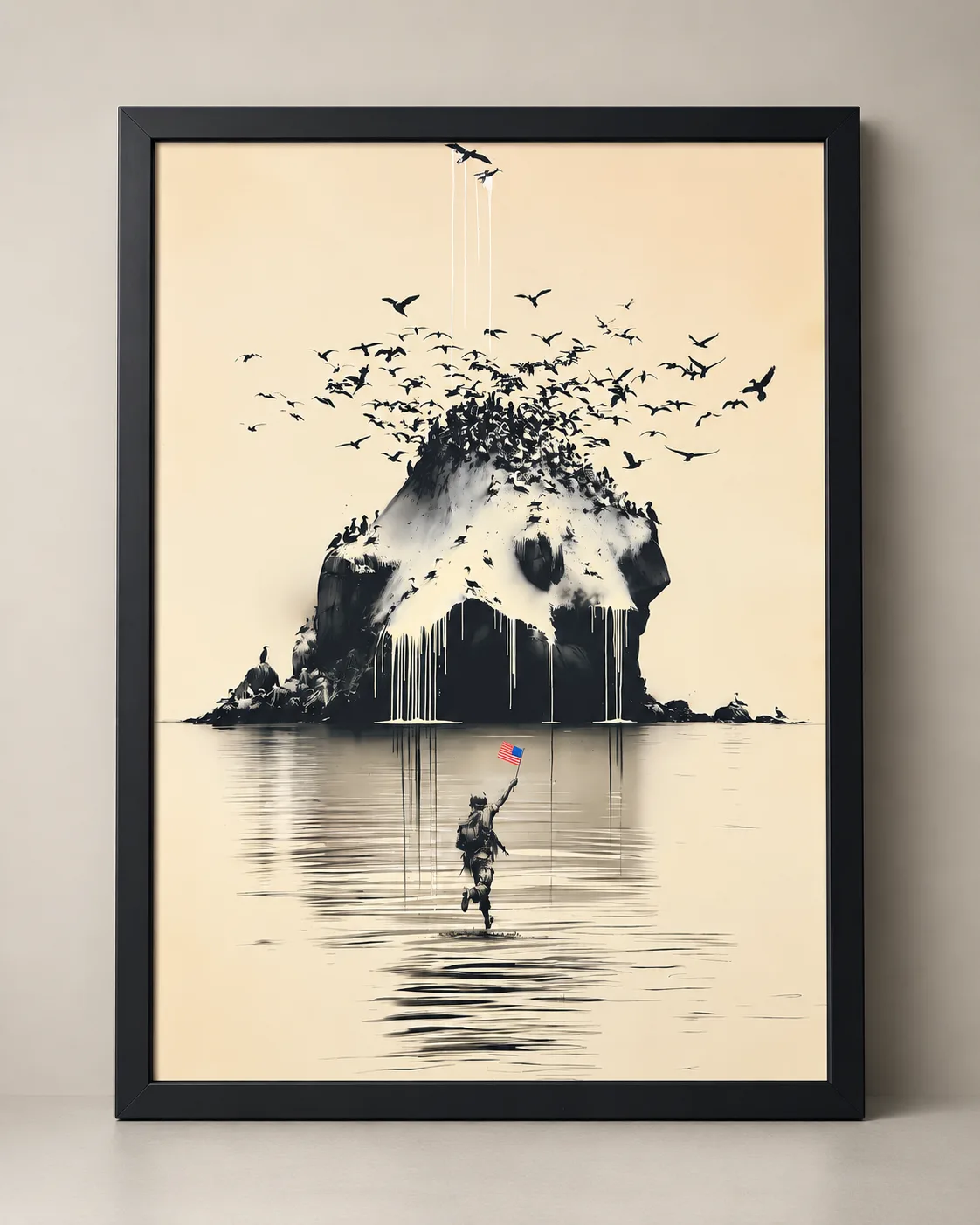
On August 18, 1856, Congress passed the Guano Islands Act, letting any U.S. citizen claim unclaimed islands containing guano, a prized nineteenth-century fertiliser, for the United States. Roughly 94 islands were claimed under it, and the law, still in force today, became the legal foundation for America’s first overseas territories.
What was the Guano Islands Act of 1856?
The Guano Islands Act, signed by President Franklin Pierce on August 18, 1856, allowed any U.S. citizen to claim an unclaimed, unoccupied island containing guano deposits on behalf of the United States. At the President’s discretion, the island could then be considered as “appertaining to” the U.S. — a deliberately vague status that let America claim islands without formally colonizing them.
The Act existed because American farmland was exhausted and Peru controlled the world’s richest guano supply on its Chincha Islands, selling it at a premium the U.S. couldn’t match. New York Senator William H. Seward introduced the bill in May 1856, arguing there was “no temptation whatever for the abuse of authority” since claimed islands would simply “revert and relapse” once their guano ran out. It passed the Senate that July and the House in August, becoming law within three months — remarkably fast for a Congress otherwise consumed by the sectional crisis over slavery.
The law’s language was carefully hedged. It didn’t annex territory outright — it let islands “appertain” to the United States, a term with no fixed meaning in international law, so Congress could claim sovereignty-adjacent rights without the political fight of formal colonization. That ambiguity proved durable: legal historian Christina Duffy Burnett has argued the Act laid the legal groundwork later reused to justify American control over Puerto Rico, Guam, and the Philippines after 1898, making a law written for bird droppings the quiet ancestor of U.S. overseas empire.
| Fact | Detail |
|---|---|
| Date | August 18th, 1856 - signed by President Franklin Pierce |
| Location | United States federal law; islands claimed across the Pacific Ocean and Caribbean Sea |
| Key figures | Sen. William H. Seward (sponsor); President Franklin Pierce (signed it); Alfred G. Benson (American Guano Company); the Black labourers of Navassa Island |
| Outcome | 94 islands claimed, 66 formally recognised by the State Department by 1903; became the legal foundation for US overseas territorial expansion |
| Status today | Still in force, 8-10 islands remain U.S territory, mostly National Wildlife Refuges; Navassa still disputed with Haiti |
Why was guano so valuable in the nineteenth century?
Guano — dried seabird excrement — was the era’s most powerful fertilizer, packed with nitrogen and phosphates that could triple crop yields on exhausted farmland. It was also refinable into saltpeter for gunpowder. Peru’s rain-free Chincha Islands held guano deposits over 150 feet deep, giving Peru a near-monopoly that made the substance one of the most valuable commodities in the Atlantic world.
By 1850, guano accounted for 22 percent of all commercial fertilizer used in the United States; a decade later it was 43 percent, despite costing an average of $73 a ton — a price American farmers resented but paid anyway. Prussian naturalist Alexander von Humboldt had first carried guano samples to Europe around 1804, and his writings on its fertilizing power sparked demand that Peru’s government moved quickly to monopolize, declaring guano a state resource in 1841 and licensing British trading house Antony Gibbs and Sons as its exclusive distributor.
Getting that guano was not glamorous. On the Chincha Islands, the work fell largely to Chinese indentured laborers shipped in under contracts that amounted to slavery in practice: they dug in ammonia dust thick enough to burn the lungs, under equatorial sun, with the Humboldt Current making any escape by sea a death sentence. Britain’s The Times reported in 1860 that of four thousand Chinese laborers sent to Peru’s guano pits, not one was known to have survived the ordeal.
“Whenever any citizen of the United States discovers a deposit of guano on any island, rock, or key, not within the lawful jurisdiction of any other government, and not occupied by the citizens of any other government, and takes peaceable possession thereof, and occupies the same, such island, rock, or key may, at the discretion of the President, be considered as appertaining to the United States.”
— 48 U.S.C. § 1411 (Guano Islands Act of 1856), current U.S. Code (source)
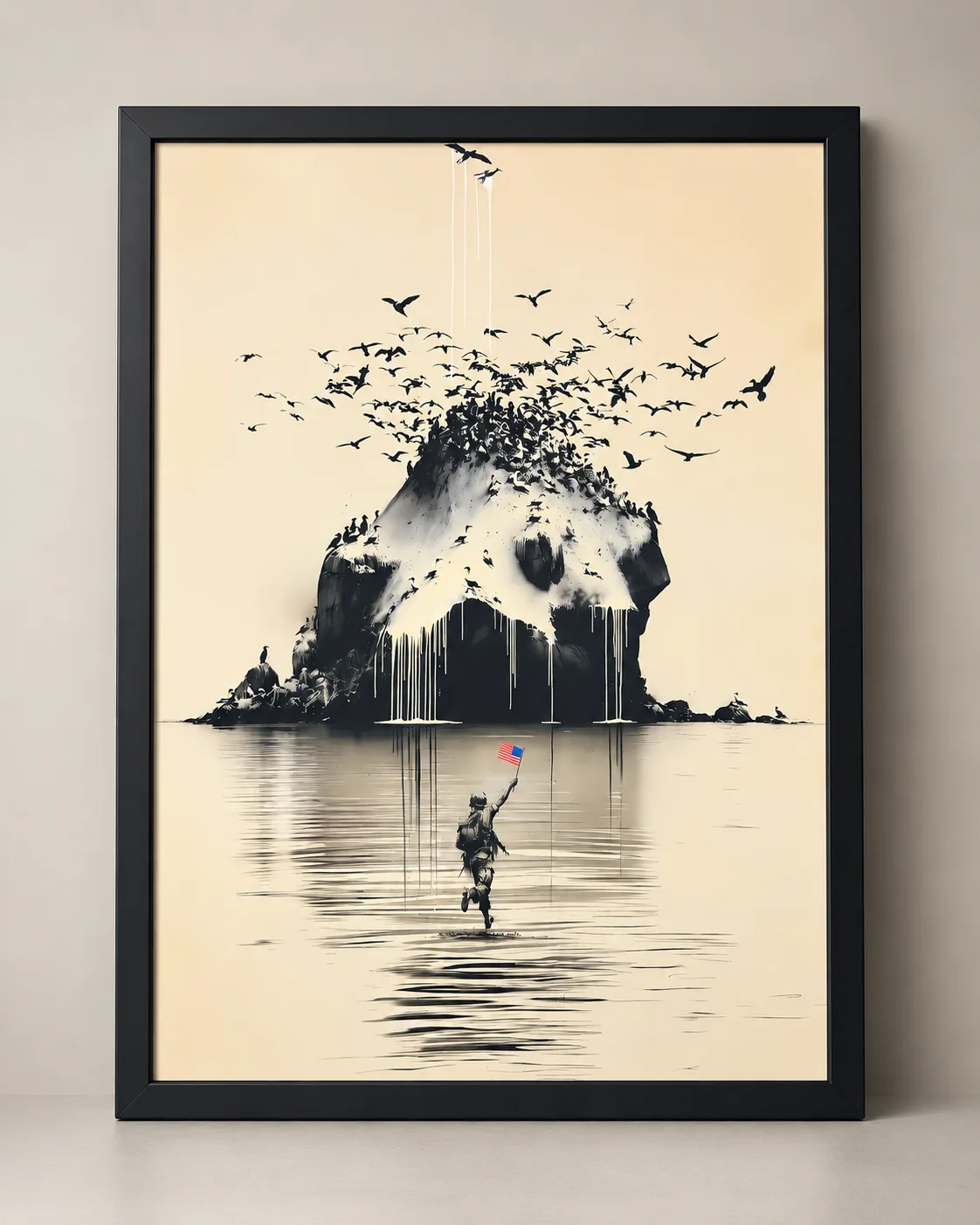
the guano cliffs reimagined in the Liquid Gold print
What happened on Navassa Island in 1889?
In September 1889, roughly 140 Black American laborers mining guano on Navassa Island revolted against their white overseers, killing five of them after years of brutal treatment. Eighteen men were shipped to Baltimore for trial; three were sentenced to death for murder. Their case reached the Supreme Court, and President Benjamin Harrison ultimately commuted all three death sentences.
Navassa is a waterless, cliff-ringed limestone rock about 35 miles off Haiti’s coast, so forbidding that early miners had to be hauled up its cliffs by grappling hook over shark-filled water. Captain Peter Duncan claimed it for the United States on July 1, 1857, and by the 1880s the Navassa Phosphate Company of Baltimore was working roughly 140 Black laborers there under a small crew of white supervisors, extracting phosphate rock from what miners called simply “the Mountain.”
The revolt itself came after years of documented abuse — withheld pay, brutal punishments, and no legal recourse, since the men worked on U.S. territory reachable only by company boat. When the case reached the Supreme Court as Jones v. United States (1890), the justices upheld the Guano Islands Act itself, ruling that whether an island belonged to America was a political question, not a legal one. Harrison’s commutation followed a petition campaign led by Black churches and civil rights organizations in Baltimore.
What islands did the United States claim under the Guano Islands Act?
Between 1856 and 1903, U.S. citizens filed claims to roughly 94 islands, rocks, and keys across the Pacific and Caribbean, of which the State Department formally recognized 66. They included Baker, Howland, and Jarvis islands in the Pacific, Navassa in the Caribbean, and dozens of smaller, now-forgotten reefs that guano companies mined and then abandoned once the deposits ran out.
The American Guano Company, formed in New York in 1855 by businessman Alfred G. Benson and his partners, moved fastest — taking formal possession of Baker, Howland, and Jarvis islands in the central Pacific in 1857 and eventually extracting an estimated 85,000 to 100,000 tons of guano from Howland alone. The State Department soon bonded these islands to the company, granting Benson’s group exclusive commercial rights while the underlying “appertaining” territory remained, in theory, the property of the United States.
Most claims followed the same short arc: a captain or company filed paperwork, a crew stripped the island of guano over a few years or decades, and then walked away once the deposits were exhausted — the Act itself specified the U.S. owed the island nothing further once that happened. Most of these claims quietly lapsed. Only a handful of islands, mainly the barren Pacific atolls too remote to be worth anything else, remained formally American once the guano rush ended.
Is the Guano Islands Act still in effect today?
Yes. The Guano Islands Act has never been repealed and remains codified at 48 U.S.C. §§ 1411–1419. In practice, though, no unclaimed guano islands are left to claim — the handful of surviving territories, including Midway Atoll, Johnston Atoll, and Navassa Island, are now managed chiefly as national wildlife refuges rather than mined for fertilizer.
Navassa itself became a National Wildlife Refuge in 1999, its old guano tramways and mining ruins now overgrown and monitored rather than worked. Haiti still names Navassa in its constitution as national territory, making it the one Guano Islands Act claim still actively disputed today. Most of the surviving Pacific claims — Baker, Howland, Jarvis, and Kingman Reef among them — sit inside the Pacific Islands Heritage Marine National Monument, one of the largest protected ocean areas on Earth.
Legal scholars still cite the Act as the origin point of American extraterritorial power — the moment Congress first worked out how to hold land abroad without formally making it part of the country. Legal historian Christina Duffy Burnett has called these guano islands “the original law-free zones,” still sitting quietly on maps long after anyone remembers why the United States owns them. A law written to settle disputes over bird droppings ended up writing the rulebook for an empire.
Sources
- Smithsonian, National Museum of American History — The Smithsonian and the 19th century guano trade
- U.S. Fish & Wildlife Service — Navassa Island National Wildlife Refuge
- U.S. House of Representatives, History, Art & Archives — Report of the Select Committee on the Guano Trade
- Christina Duffy Burnett, American Quarterly 57:3 (2005), “The Edges of Empire and the Limits of Sovereignty: American Guano Islands"
Lost Axis Editorial
Researches each story from primary sources · About Lost Axis →
Early access to each new edition, before it's public.